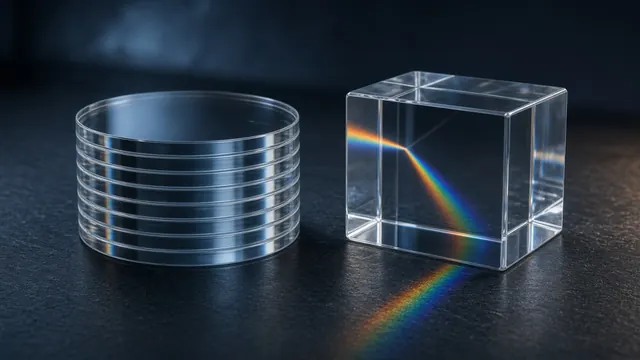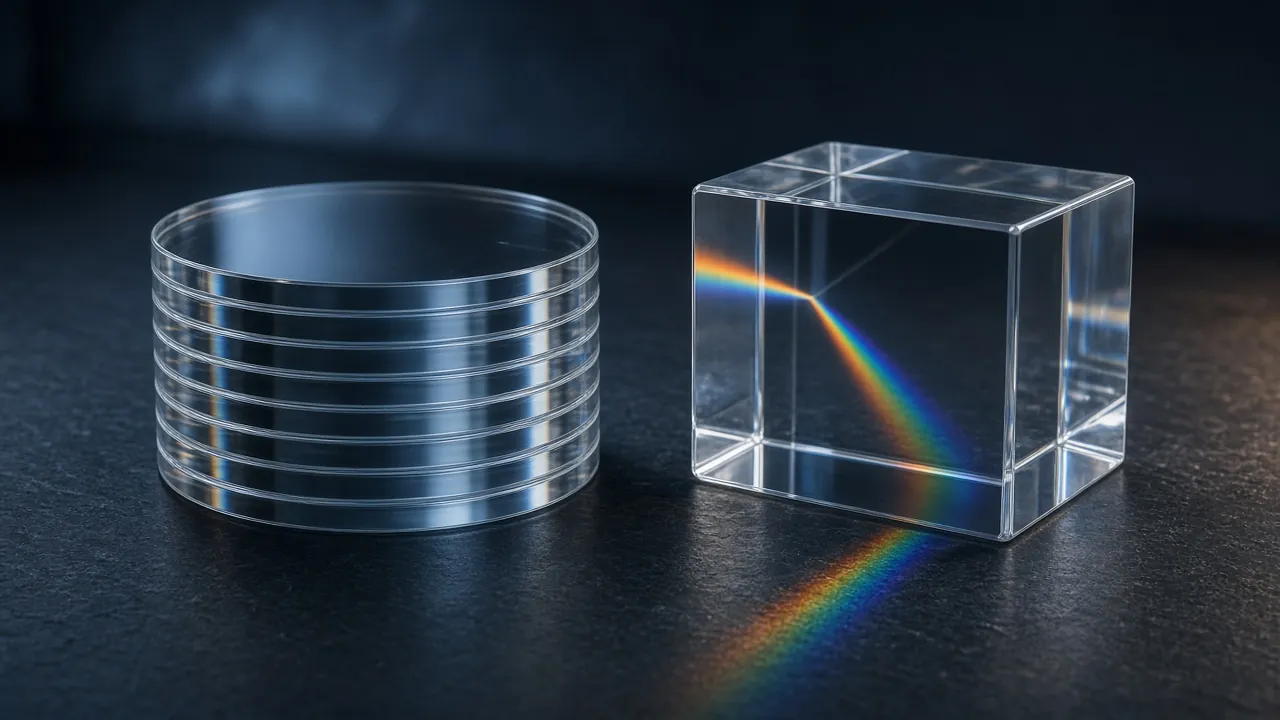
Glass as an optical medium
Optical glass is engineered around its interaction with light. Composition and thermal history set refractive index, dispersion, transmission windows, homogeneity and mechanical behaviour. The International Commission on Glass runs a technical committee dedicated to photonic glasses and optical fibres.1
Material families
Silicate glasses provide a mature manufacturing base. Phosphate, fluoride and chalcogenide compositions offer different chemical environments and transmission profiles, chosen according to wavelength band, component geometry and operating conditions.
Composition and precision
Optical design connects material properties to the finished lens, window, waveguide or fibre. Spectral transmission, refractive index, birefringence and surface quality guide selection, and Tampere University's facilities show the range of structural and optical characterisation used in glass development.2
From material to component
A formulation becomes useful through controlled melting or deposition, shaping, annealing, polishing and coating. For wearable optics, SCHOTT's RealView® 2.0 lightweight wafer pairs a refractive index of about 2.0 with a density below 4 g/cm³, a material platform engineered for AR waveguides.3
Sources
- TC20: Photonic Glasses and Optical FibersInternational Commission on Glass
- FacilitiesTampere University · Photonic Glasses group
- SCHOTT introduces RealView® 2.0 lightweight glass wafers to advance the next generation of AI smart glassesSCHOTT · 3 September 2026